
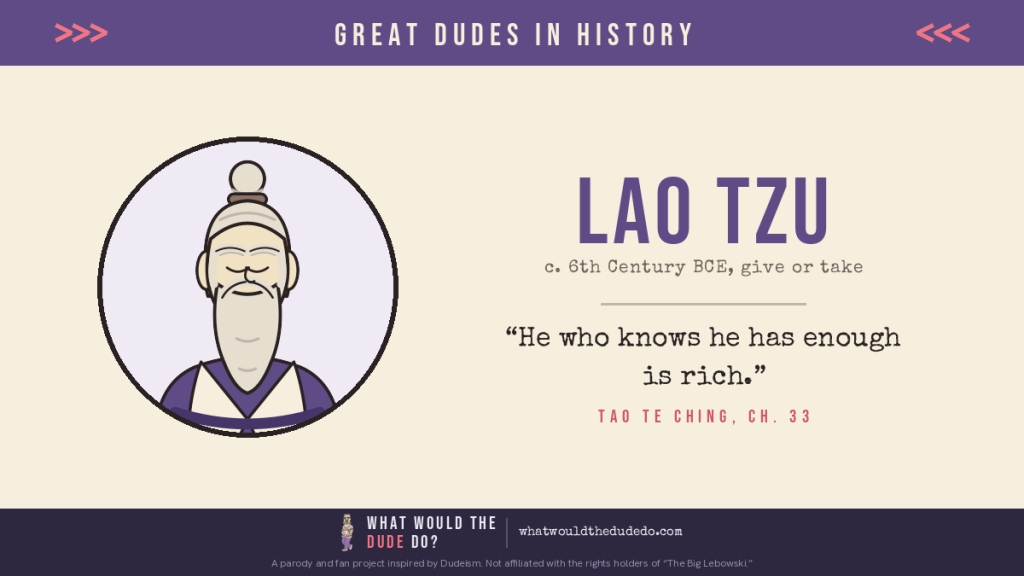
Here’s the thing about the Tao Te Ching, man. It’s one of the most translated books on the planet. Eighty-one little chapters. About five thousand characters, which is shorter than most people’s out-of-office reply. And according to the oldest story we’ve got, the guy who wrote it did so under mild protest, on his way out of town, because a gatekeeper wouldn’t let him through until he put something on paper.
Then he left. No follow-up. No part two.
That’s it. The Dude’s whole story. There isn’t a part two.
The guy, as much as anybody knows
Lao Tzu means “Old Master,” which is less a name than a job description. The earliest biography we have comes from Sima Qian, a court historian writing around 100 BCE, which is to say a few hundred years after the fact. Even he sounded a little unsure about it.
But…that’s how history happens, man…lot’s of threads in the ol’ Duder’s head, y’know.
The story goes like this. There was a man named Li Er who kept the archives for the Zhou court. An archivist, if you will. He spent his working life around other people’s records, watching the dynasty he worked for slowly come apart. At some point he’d had enough of the whole durned scene, so he got on an ox and headed west.
At the pass out of the kingdom, a gatekeeper named Yinxi recognized him and said, more or less, you’re not going anywhere until you write down what you know. So Lao Tzu sat down, wrote the thing in two parts, handed it over, rode through the gate, and vanished from the record entirely. Nobody knows where he went or what happened to him.
Modern scholars will tell you it’s more complicated. The oldest physical copies we have, bamboo slips from around 300 BCE, look like a text that got assembled over time by more than one hand. There’s a decent chance “Lao Tzu” is a composite, or a legend, or a name people hung on a pile of collected sayings. Fine. The Dude isn’t a documented historical person either – his is also an amalgamation of a few different Dudes – and here we are.
What the old man actually said
You could spend a life on this book and people have. But three ideas really tie the whole durned thing together, and all three would go over just fine on a rug in Venice.
Stop forcing it.
Wu wei. Effortless action. Doing without doing. Not laziness, and not sitting on your hands, but working with how a thing already wants to go instead of shoving it. Water carves canyons without ever once straining. We’ve gone on about this before around here, so we’ll leave it there.
Know when you have enough.
Chapter thirty-three, roughly: he who knows he has enough is rich. Not “he who has a lot.” Not “he who is on track to have a lot by Q4.” Just knowing where the line is. Most of the tension people carry around isn’t caused by lacking something. It’s caused by not knowing when to stop counting.
Soft beats hard, given time.
Water over stone.
The Dude over the Walter.
The yielding thing outlasts the rigid thing. This one’s counterintuitive to anyone who grew up thinking strength means tension, but you already know it’s true. You’ve watched somebody get more upset than the situation called for, and you’ve watched somebody just let it roll off, and you know which one of them slept better.
Why he’s a Dude
Because he had every opportunity to build a whole thing out of it and didn’t.
Think about what a guy in that position would do today. Newsletter. Retreat in the desert. Cohort-based course on flowing like water, spots limited. Instead he wrote five thousand characters because somebody physically blocked the road, and then he rode off on an ox and was never heard from again. He didn’t stick around to defend it. He didn’t correct anybody’s interpretation. He didn’t check how it was doing.
He also never claimed to have it figured out. The book opens by admitting that the thing it’s about can’t really be put into words, and then goes ahead and takes eighty-one short chapters at it anyway, which is either very humble or very funny or both. That’s the register. Mellow, self-aware, unbothered.
The Dude abides in a bathrobe. Lao Tzu abided on an ox. Different props, same guy.
Something small to try
Pick one thing this week you’ve been forcing. Just one. A conversation you keep rehearsing, a project you keep gripping, a person you’re trying to change. Set it down for a few days and see whether it actually falls apart without your hand on it.
Most of the time it doesn’t. That’s the whole durned lesson, and it only costs you a week to find out.
Take it easy, man.
Before you go
Got something on your mind? Ask the Dude and see what he says. He’s brief, which you’d probably appreciate about now.
Or go look at the shirts. The whole durned rack is over here, and nobody’s going to hassle you about it.
A parody and fan project inspired by Dudeism. Not affiliated with, endorsed by, or connected to the rights holders of “The Big Lebowski.” The Dude is a state of mind, man.